
Technique
The Technique subcollection directly relates to the fields that address linguistically mediated conflict in an applied setting, addressing language problems as they relate to conflict, evaluating procedures, or recommending specific protocols and techniques related to addressing that conflict. You will find a variety of fields represented here, pay attention to how the context of conflict impacts the strategies employed!
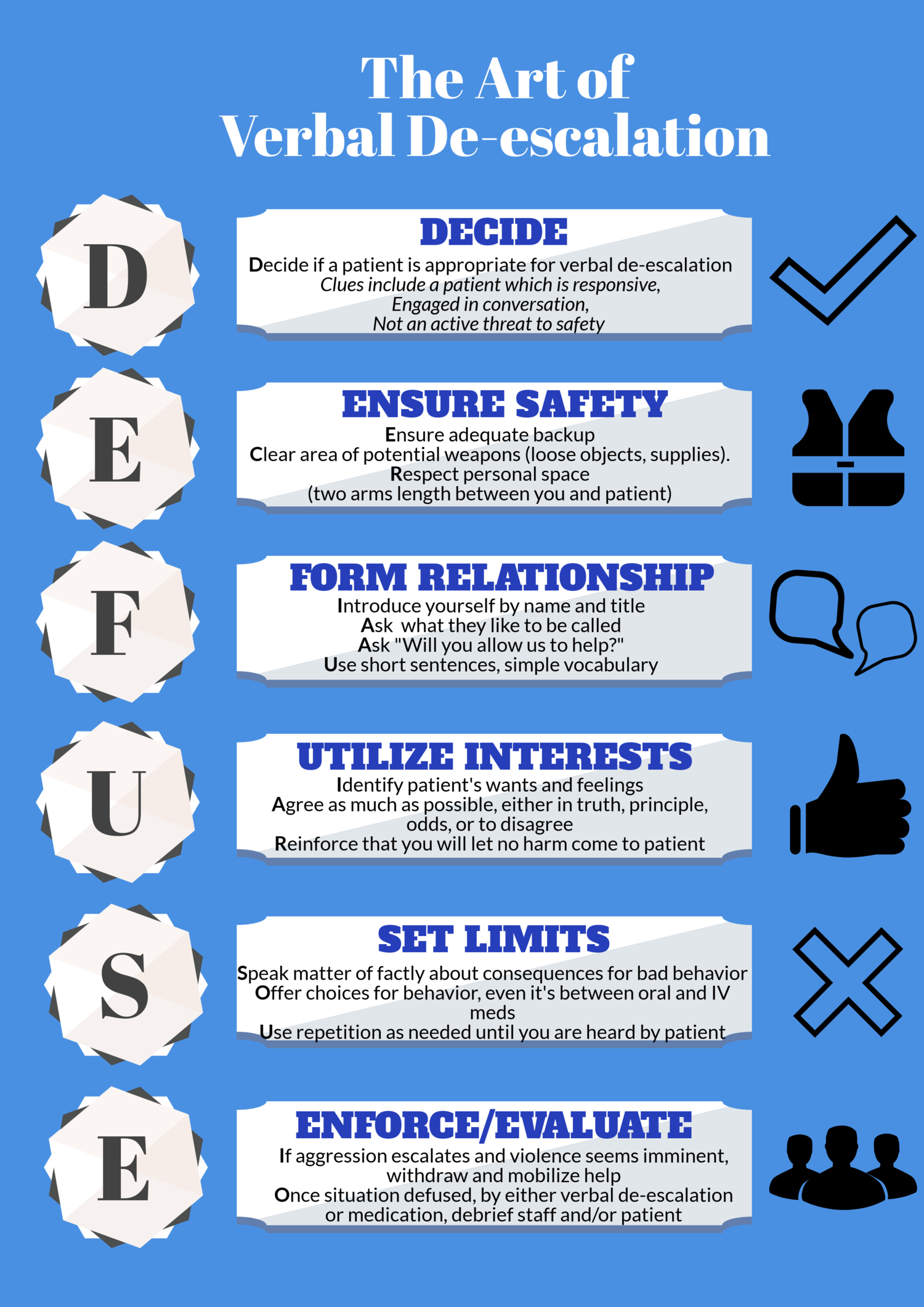
Eswaren, et al, Verbal De-escalation in the ED, 2019
Avoiding interactional conflict in dementia: The influence of gender styles in interactions
Sociolinguistic research in the general population has established the existence of gender differences in the social use of language. In particular, it has been noted that women use more markers of politeness, small talk and structural devices (e.g. minimal responses, tag questions) to help maintain their conversations. Analysis of interactions involving people with dementia (PWD) suggests that these gender based differences were still present in the face of dementia. Furthermore, the use of these forms of language helped the women with dementia to avoid conflict and extend the length of their interactions. This study investigated whether the use of such language helped or hindered women with dementia in maintaining conversational satisfaction.
Guendouzi’s work takes place within the clinical realm of interactions (a recurring theme), what makes this so interesting is its methods of conflict management respective to a patient with a diminished sense-of self. De-escalation is so rarely rational and to approach a linguistic understanding we must engage with the often messy and uncomfortable features of linguistic conflict which includes agents that aren’t entirely alert and oriented. Not only does it cut an interesting research niche, but this article is an important piece for us to examine as it provides insight into the communities where conflict could be a concurrent problem.
Jackie Guendouzi, Jackie Guendouzi, Guendouzi, J., Ashley Bourque Meaux, Meaux, A., Nicole Müller, & Müller, N. (2016). Avoiding interactional conflict in dementia: The influence of gender styles in interactions. 4(1), 8–34. https://doi.org/10.1075/jlac.4.1.01gue
Exploring vague language use and voice variation in human-agent interaction
This thesis addresses the linguistic phenomenon of vague language (VL) and its effect on the creation of identity in the emerging and developing field of human-agent interaction (HAI). Current research on VL has focused on human interaction, while similar existing literature on language in HAI has focused on politeness theory and facework. This thesis brings the two research fields together and uses them as a focusing lens to investigate the issue of identity in agents – software with varying degrees of autonomy and intelligence.
Similarly to the previous article, this article by Clark investigates some messy language data Vague Language (VL) within a very unique setting that being human-agent interaction (HAI). A bit far out there HAI study examines and analyzes the strengths and weaknesses of both humans and machines. Combined with a focus on a salient linguistic function and relating to meaning-making on the pragmatic level I found this article to fit our curation. Useful for those wanting to approach the growing field of human-machine linguistic interactions.
Leigh Clark, & Clark, L. (2016). Exploring vague language use and voice variation in human-agent interaction.
Im/politeness, Rapport Management and Workplace Culture: Truckers Performing Masculinities on Canadian Ice-Roads
This chapter analyses the interplay between linguistic im/politeness, gender and workplace culture in a series of interactions between groups of men working on Canadian ice-roads as seasonal truck drivers. The data are taken from the documentary series Ice Road Truckers, which has been broadcast on a number of commercial television networks in a range of locations including the USA, the UK, Australia, New Zealand and the Netherlands.1
For a far more grounded yet still unique article look no further than Mullany’s work on (Im)politeness within the Canadian Ice-Roading community of practice. Not only do we see attention towards a working class discourse environment we also see attention towards the gendered markers of discourse. This article combines all of the socio-cultural influence of the works in the Analysis subcollection and applies it to an interesting sight. Very worth it for researchers or those interested in working class and marginalized discourse communities.
Louise Mullany, & Mullany, L. (2011). Im/politeness, Rapport Management and Workplace Culture: Truckers Performing Masculinities on Canadian Ice-Roads. 61–84. https://doi.org/10.1057/9780230305939_4
CONSTRUCTING A PROPOSAL AS A THOUGHT: A WAY TO MANAGE PROBLEMS IN THE INITIATION OF JOINT DECISION-MAKING IN FINNISH WORKPLACE INTERACTION
Drawing on fifteen video-recorded planning meetings as data, and on conversation analysis as a method, I examine the interactional import of the common Finnish practice of constructing a proposal as a thought. As a point of departure, I consider two different types of conditional utterances in which a speaker presents a plan: (1) ‘asking conditionals’ (jos ‘what if’ prefaced declarative conditionals and interrogative conditionals) and (2) ‘stating conditionals’ (declarative conditionals). While asking conditionals mark the plan as contingent on the recipient’s approval and involve a straightforward request for the recipient to engage in joint decision-making about the proposed plan, stating conditionals are regularly treated as informings about plans in which the recipients have actually no word to say. However, when asking and stating conditionals are prefaced with references to the speakers’ thoughts (ma aattelin et ‘I was thinking that’), the projected responses and sequential trajectories are more open-ended: The participants have the opportunity to share the responsibility, not only for what is to be decided with respect to the proposed plan, but also for what is to be jointly decided upon in the first place. Constructing a proposal as a thought seems thus to be a practice with which participants may enable the symmetrical distribution of deontic rights at the very beginning of joint decision-making sequences.
We had to have some language-cultural variation in this subcollection and Stevanovic’s work on the discourse of Finnish Workplace interactions fit the bill. This collection also serves as an insight into the process of grammaticalizing conflict management as a distinct linguistic marker starts to emerge which directly serves to resolve potential conflict within a very specific occupational domain. Scandinavian conflict has always been interesting to me, as the Scandinavian language culture tends towards high individuality and distance conflict seems a little tame in comparison to the heated New York American English conflicts we might see on the street.
Melisa Stevanovic, & Stevanovic, M. (2013). CONSTRUCTING A PROPOSAL AS A THOUGHT: A WAY TO MANAGE PROBLEMS IN THE INITIATION OF JOINT DECISION-MAKING IN FINNISH WORKPLACE INTERACTION. Pragmatics, 23(3), 519–544. https://doi.org/10.1075/prag.23.3.07ste
Cooperation, Conflict and Control: Parent-Teacher Relationships in an English Secondary School.
In this paper, we present the findings which have emerged from our investigation of parent–teacher conversations at one secondary school in the north-west of England. Data were collected in the form of audio recordings over two years, supplemented by supporting evidence in the form of one-to-one interviews with parents, teachers and students. We analyzed our data utilizing conversation analysis (CA) and interpreted our findings using politeness theory. Our research revealed that the parents and teachers at this school appeared predisposed towards building friendly, mutually supportive relationships. They did not, however, jointly decide what their aims would be, share responsibility for learning or engage in meaningful dialogue. Also, teachers tended to assume authority on educational matters whilst parents played a supporting role or acted as passive receivers of information. We discuss these behaviors in the light of the various perspectives from which parent–teacher relationships have been viewed. We also consider the practical implications of our findings for both schools and families, and recommend future lines of inquiry for those wishing to explore this under-researched educational practice.
In an applied Linguistic scope, Bilton et al’s work specifically targets the English secondary school site and describes not only the facets and features related to conflict within that zone but also highlights the distinct utilization of cooperation as a means for conflict management. Very useful for us to examine how this age group and site interact and emerge linguistically mediated conflict and conflict resolution. As well as, useful for any educator in general who may interact with their learner’s parents.
Richard Bilton, Bilton, R., Alison Jackson, Jackson, A., Barry Hymer, & Hymer, B. (2018). Cooperation, Conflict and Control: Parent-Teacher Relationships in an English Secondary School. Educational Review, 70(4), 510–526. https://doi.org/10.1080/00131911.2017.1410107
Classroom behaviour and facework: balancing threats and enhancements
This paper discusses teachers’ utterances in relation to pupils’ social behavior and examines this aspect of classroom discourse from the perspective of theories of face and politeness. It is suggested that the utterances teachers use in relation to pupils’ social behavior are potentially different from those used when referring to pupils’ academic work, and this is investigated by exploring patterns in teachers’ utterances in terms of their potential to comprise either face‐threatening acts or the equivalent face enhancements. The data are taken from a study conducted in a UK secondary school, where the school has followed government guidance and is using a system of rewards and sanctions in relation to pupils’ social behavior in the classroom. Speech data were collected through 12 hours of lesson observations, with the lessons being voice‐recorded and transcribed and then categorized in terms of whether utterances addressed classroom tasks or classroom behavior.
Another piece within the applied linguistics and educational research scope Payne-Woolridge specifically targets classroom management with a pragmatic framework. Very interesting to examine intergenerational conflict management within in educational site. For those who are pre-service teachers working with youth, this article could provide serious linguistic insights into the techniques related to classroom management.
Ruth Payne‐Woolridge, & Payne‐Woolridge, R. (2010). Classroom behaviour and facework: Balancing threats and enhancements. 1(2), 167–180. https://doi.org/10.1080/19463014.2010.514193
The Pragmatics of Negotiation in Peace Treaties
It is proposed that negotiation is an interpersonal interaction in which the people involved try to arrive at an agreement to resolve a conflict. Negotiation is prevailing in the political field where politicians frequently appeal to it in order to resolve conflicts and get at the best outcomes. The present study investigates negotiation from a pragmatic point of view in peace treaties. It hypothesizes that negotiators employ a panorama of strategies in order to achieve their negotiation outcomes. Additionally, it aims at answering the following questions: What are the functions of negotiation produced in the data under study? What are the types of negotiation resorted to by the participants involved? What is the pragmatic structure of negotiation produced in the data under scrutiny? And what are the pragmatic strategies of negotiation utilized in peace treaties?
This article written by Saffa M.D. is a very interesting look into a pragmatic analysis of negotiation on a world scale and provides unique insight into the pragmatics of high-stakes conflict management and resolution building. For those interested in global studies and particularly the process of peacemaking this article should used as a trailhead and framework for approaching further negotiations. I must iterate the importance of these materials here, Science like this article is actively being purged within the United States as of now, one can only imagine the consequences of destroying our collective understanding of peaceful negotiation.
Saffah, M. D. (2022). The Pragmatics of Negotiation in Peace Treaties. 67.
“Building a thick skin for each other”: The use of ‘reading’ as an interactional practice of mock impoliteness in drag queen backstage talk
Although queer linguistics has long acknowledged the playful use of potentially impolite utterances by LGBT people to build in-group solidarity these practices have not been analyzed from a socio-pragmatic approach, nor have they been mentioned in the general pragmatics literature. Responding to these two gaps, the present study examines the functional use of the interactional practice ‘reading’ in the backstage talk of four drag queen performers. By employing a mock impoliteness analytical framework ( Haugh & Bousfield 2012 ) this study shows how these utterances, which could potentially be evaluated as genuine impoliteness outside of the appropriate context, are positively evaluated by in-group members who recognize the importance of “building a thick skin” to face a hostile environment from LGBT and non-LGBT people. This study also seeks to draw attention to the use of backstage talk, and supplemental interview data, to uncover drag queen cultural practices through language use.
A wonderful research article which examines the Drag-Queen discourse community of practice of ‘Reading’ – a process for which drag queens insult one another. This article not only provides insight into a underrepresented culture of practice it combines a thorough pragmatic analysis. For our purposes within this curation it can be used to see variation as a source of potential linguistic conflict – as reading occurring outside of the appropriate context could be very misunderstood, and as reading itself is a speech act relying on (im)politeness.
Sean McKinnon, & McKinnon, S. (2017). “Building a thick skin for each other”: The use of ‘reading’ as an interactional practice of mock impoliteness in drag queen backstage talk. 6(1), 90–127. https://doi.org/10.1075/jls.6.1.04mck
THREE ESSAYS IN THE SOCIOLOGY OF VIOLENCE: REPERTOIRE PARALYSIS, LOCALIZED DIFFUSION, AND EMOTIONAL INTERVENTIONS IN DE-ESCALATION
The essays in this dissertation apply a micro-first sociology of violence to three topics operating at several different timescales–decades, years, days, and minutes.
The first paper considers the evolution of collective violence over fifty years. This study asks whether the emergent nature of violence prevents violent forms of contention from evolving as quickly as others. Using a custom algorithm, I matched entries in a database of ethnoreligious violence in India with source articles from the Times of India archive. I categorized and counted the verbs in these articles, and the same verbs in a random sample of 10,000 articles from the same time period. I find that verbs related to violence show more stability than verbs related to other forms of collective action.
The second paper considers two processes of diffusion–a years-long process of violence diffusion constituting a wave of ethno-religious violence in India from 1977 to 1992, and a days-long process of diffusion where one incident of collective violence may spark others. I use an event-history framework and a recently-developed GIS data cross walking procedure to compare demographic, electoral, economic, and diffusion variables across India at the level of parliamentary constituencies. The large- and small-scale diffusion variables are strong predictors of violence. In particular, diffusion patterns are consistent with regional language media as a vector for violence, with uptake more likely where the majority group’s economic or demographic dominance is less pronounced.
The third paper considers a thirty-minute process of de-escalation after a gunman threatened to commit a school shooting. Using audio and video recordings along with a memoir, I analyze how the school bookkeeper, acting as hostage and negotiator, convinced the gunman to surrender. The turning point resulted from two emotional processes, one bolstering the bookkeeper, the other exhausting the gunman. These processes created an opening for processes of deliberation, identity repair, and rapport-building to proceed.
the third paper is what landed this sociology doctoral dissertation within this curation, emotional interventions in de-escalation. Providing excellent insight into the emotional realm in terms of conflict resolution it is a foundational reading for those interested in developing their understanding and techniques for conflict de-escalation.
Sorge, D. C. (2022). THREE ESSAYS IN THE SOCIOLOGY OF VIOLENCE: REPERTOIRE PARALYSIS, LOCALIZED DIFFUSION, AND EMOTIONAL INTERVENTIONS IN DE-ESCALATION. https://repository.upenn.edu/entities/publication/139fe59f-a11b-4a6c-9568-fdd43fcafc0d
“I want a real apology”: A discursive pragmatics perspective on apologies
Research on the apology spans over half a century and has been quite prolific. Yet, a major issue with numerous studies on apologies is a lack of findings from naturally occurring interaction. Instead many studies examine written elicitations. As a result they research how respondents think they apologize, not how they do apologize. This project, in contrast, stresses the importance of studying the apology as a dynamically constructed politeness strategy in situated interaction. Apologies are part of the ever-present relational work, i.e., co-constructed and co-negotiated, emergent relationships in a situated social context. Hence, the focus is not on the illocutionary force indicating device (IFID) alone, nor on the turn in which the IFID is produced, but on the interactional exchange in situ. Naturally, data eliciting produces a larger sample size of apologies than the taping and transcribing of naturally occurring interaction does. To remedy the issue, this study uses interactions from situation comedies, which provide a large sample of apologies in their interactional context. Sitcom interactions constitute a valid focus of pragmatic research as they share fundamental elements of natural interactions ( B. Mills 2009 ; Quaglio 2009 ). The validity of this approach is tested using findings from published conversation analytic studies on apologies. The analysis is set within the framework of discursive pragmatics and leads to new insights on apologies and responses to apologies.
Rieger’s research article “I Want a Real Apology” is a thorough work examining a specific speech act within the greater language conflict system – that being the apology. This work provides a strong framework in relational and emergent theory as it relates to pragmatics and is a salient feature to work with. For this subcollection it serves as a peak cumulation of greater curation, with strong theory, distinct feature and related techniques, and as a media analysis. Very worth checking out for a prime example of research that synthesizes conflict pragmatics research.
Caroline L. Rieger, & Rieger, C. L. (2017). “I want a real apology”: A discursive pragmatics perspective on apologies. Pragmatics. Quarterly Publication of the International Pragmatics Association, 27(4), 553–590. https://doi.org/10.1075/prag.27.4.04rie
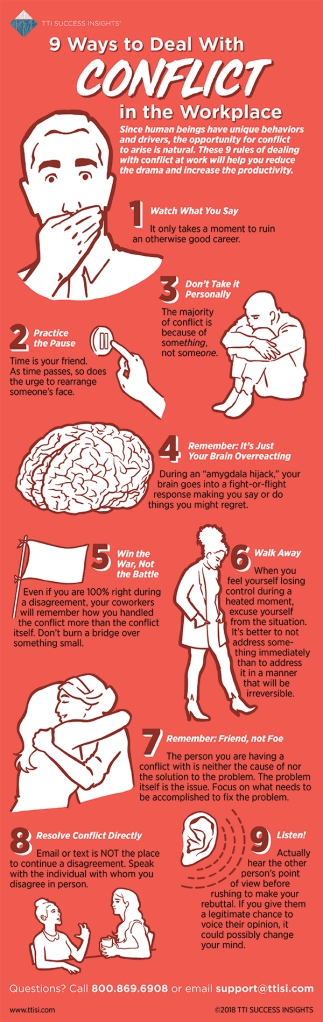
TTI Success Insights, Conflict Infographic, 2018
This infographic is very business-oriented and forward-facing. This is a typical manifestation of the conflict resolution genre, typically an infographic with all the trappings of engagement, and tailored to a particular occupational context.
This is a useful blogpost on the psychology today platform that targets the emotional crisis de-escalation context. For those interested this would be a must-read for those encountering emotional crises. It also provides a clean aesthetic and clear communication of these concepts, useful for those wanting to produce forward-facing de-escalation material.
https://cmcoutperform.com/The-Five-Steps-to-Conflict-Resolution
Another example of the business-oriented conflict management handbook-styled tutorial. What is of interest here is the fact that this comes from the Canadian Management Center and may provide a fine-grain manifestation of Variation in conflict management techniques as compared to their North-American counterparts.
Another entry from our Psychology Today blog post but specifically tailored to the language for conflict management. This is an interesting manifestation of the conflict-management genre as it delineates the conflict with individuals rather than situations. Alongside the mental health care industry this manner may be conflict conducive and of note. Conflict management instruction may be conflict-conducive.
This is another entry in the private occupation-facing facing post instructing techniques on conflict management. What stands out here is it’s thoroughness and accessibility to agents of differing occupations. Potentially providing insight into wider audience communications of conflict management.
 N. Shepard | University of Oregon