
Analysis
The Analysis subcollection is specifically tailored to fields of research that seek to describe and analyze the features and phenomena related to linguistically mediated conflict and conflict de-escalation. Supplementing external material includes blogposts as well as naturalized conflict Youtube material that after being supplemented with the salient features related to linguistically mediated conflict one could watch an engage in their own linguistic conflict analysis.
Evaluation, Conflict and Prescriptive Metapragmatic Comments: (Re)constructing Transmedia Stories
Bou-Franch carries out an empirical study of evaluation, discursive patterns of conflict and prescriptive metapragmatic comments. The author takes a metapragmatic approach (Culpeper,.Impoliteness: Using Language to Cause Offence, Cambridge University Press, Cambridge, 2011; Kádár and Haugh,.Understanding Politeness, Cambridge University Press, Cambridge, 2013; Verschueren,.Pragmatics 10:463–498, 2000) to explore the interconnections of evaluative patterns of conflict with social norms and moral values in a corpus of online commentary published in response to reports of a sport controversy. She argues that the sports controversy, alongside the reports and commentary it triggers, constitute a transmedia story (Jenkins,.Convergence Culture: Where Old and New Media Collide, New York University Press, New York, 2006). In addition, she focuses on the linguistic realization and sociopragmatic functions of prescriptive metapragmatic comments, which have received scant scholarly attention. She concludes with an analysis of the ways in which the online commentary under scrutiny indexes ideology and contributes to expand the transmedia story.
This is a very interesting article with an explicitly Lavender Linguistics flavor, examining the pragmatic features related to the controversy of transgender athletes. Relevant for those interested in a contemporary analysis of discourses, narratives, and the meta-pragmatics of controversy. As it relates to the Analysis subcollection, this article provides insight into the process and theorization approaching modern-day linguistic conflict. As it relates to the greater curation project I thought it necessary to highlight contemporary and innovative research to provide a sense of what relatively new conflict pragmatic conflict analysis looks like and how a contemporary researcher tackles delivering that information to an audience.
Bou-Franch, P., Blitvich, P. G.-C., & Patricia Bou‐Franch. (2021). Evaluation, Conflict and Prescriptive Metapragmatic Comments: (Re)constructing Transmedia Stories. 189–217. https://doi.org/10.1007/978-3-030-84602-2_8
Exploring the interplay of gender, discourse, and (im)politeness
Drawing upon the method of discourse analysis, this article explores the complex relationship between gender, discourse, and (im)politeness. By examining an extended excerpt of interaction taken from the popular US reality TV show The Apprentice, I examine the role of gender stereotyping and gender assumptions in the assessment of (im)politeness by the discourse participants. Following Mills (2002), I shall argue that gender plays a role in the judgments of (im)politeness by the interactants, and that judgments seem to vary among individuals. The analysis shows that a woman’s relatively masculine verbal behaviour, albeit politic in view of the stereotypically ‘masculine’ context, is perceived as inappropriate and impolite. It is suggested that women professionals may be subjected to more stringent gender norms which govern what constitutes polite behaviour, as linguistic behaviour may be evaluated against the ‘norms’ of women’s speech which is assumed to be stereotypically more polite than men’s speech. The analysis also raises the issue of a double bind (Lakoff 1975) that women may confront regularly in the work-place.
Although this article takes upon a method of Discourse-media analysis of the TV show The Apprentice I believe as it operates on an overall descriptive approach it is fitting for the Analysis subcollection. For those interested one can find explorations on facets of identity (gender) and the manifestations of pragmatic conflict via (im)politeness. As well as, historically and politically relevant analysis conducted on The Apprentice provides insight into the analytic process and conceptualizations of what is considered impolite on a constructed platform such as The Apprentice. Minoritized populations suffer from a larger (im)politeness burden and it’s worth platforming research which serves to better our greater understanding of those experiences.
Chit Cheung Matthew Sung, & Sung, C. C. M. (2012). Exploring the interplay of gender, discourse, and (im)politeness. Journal of Gender Studies, 21(3), 285–300. https://doi.org/10.1080/09589236.2012.681179
Explosive Conflict: Time-Dynamics of Violence
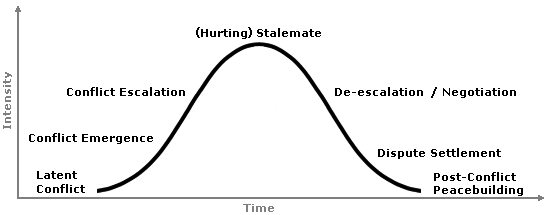
Conflict escalates through a series of feedback loops. On the micro level, conflict generates conditions for intense interaction rituals, and internal solidarity fuels external conflict. Perceived atrocities reciprocally increase ideological polarization between opponents, while confrontational tension/fear makes violence incompetent and produces real atrocities. Conflict groups seek allies, drive out neutrals, and mobilize material resources. Both sides in a conflict counter-escalate through the same set of feedbacks. Winning and losing are determined by differences between rates of escalation and by attacks that one-sidedly destroy organizational and material capacity. Conflict de-escalates because both sides fail to find conditions for solidarity, cannot overcome confrontational tension/fear, and exhaust their material resources. Emotional burnout sets in through a time dynamic of explosion, plateau, and dissipation of enthusiasm. Defection of allies opens the way for third-party settlement. When both sides remain stalemated, initial enthusiasm and external polarization give way to emergent internal factions—a victory faction (hard-liners) versus a peace faction (negotiators)—creating new conflict identities. Ideals promoted at the outset of conflict become obstacles to resolution at the end.
This article serves as a greater theoretical conception of how conflict manifests and the social dynamics at play. For us looking at conflict within the scope of linguistic phenomena we can correlate discourse markers with social-psychological manifestations of conflict as described by Collins. Very useful and pertinent right now for attempting to understand the all too often exhausting dynamics of conflict. Enlightening in the way you could read this article and watch some of the naturalized material below and form a warranted hypothesis’ as to what stage of conflict individuals are engaging in as well as what phenomena might be associated.
Collins, R. (2021). Explosive Conflict: Time-Dynamics of Violence (1st ed.). Routledge. https://doi.org/10.4324/9781003245629
Perceptions of Impoliteness from a Cultural Linguistics Perspective
This chapter explores the role of ‘culture’ in perceptions of impoliteness from a Cultural Linguistics perspective. Recent studies of impoliteness have identified a number of factors that influence speakers’ perception of (im)polite language use. The chapter argues that Cultural Linguistics has the potential to offer a robust analytical framework for the exploration of the cultural conceptualizations that are often associated with (im)polite use of language. The framework provides a set of analytical tools for bringing to the foreground features of human languages that are entrenched in cultural conceptualizations, including cultural schemas, cultural categories, and cultural metaphors. This chapter elaborates on this proposal by presenting examples of naturalistic discourse from Persian in which speakers interpret impolite behavior in the light of a number of Persian cultural schemas. The study reported in this chapter also adopts a novel three-layered approach that combines (meta)discourse analysis with the ethnography of cultural conceptualizations for data analysis.
This article introduces formally the cultural linguistics analytic framework into the curation. Deeply useful for engaging with both inter & intra cultural linguistically mediated conflicts. Utilizing the methodology in this article one could find themselves deconstructing the cultural facets and symbolic resources in all aspects of conflict, more specifically as reality TV and cultural depictions of conflict as a whole go, they are richly packed with cultural discourse markers and symbolism for which to operate language around.
Farzad Sharifian, Sharifian, F., Tahmineh Tayebi, & Tayebi, T. (2017). Perceptions of Impoliteness from a Cultural Linguistics Perspective. 389–409. https://doi.org/10.1007/978-981-10-4056-6_18
Towards an anatomy of impoliteness.
Politeness theories have focused on how communicative strategies are employed to promote or maintain social harmony in interaction. On the other hand, little work has been done on communicative strategies with the opposite orientation, that of attacking one’s interlocutor and causing disharmony. In this paper, I consider the notions of inherent and mock impoliteness, and discuss contextual factors associated with impoliteness. In particular, I attempt to build an impoliteness framework which is parallel but opposite to Brown and Levinson’s (1987) theory of politeness. Finally, I demonstrate that in some contexts — specifically that of army training and literary drama — impoliteness behavior is not a marginal activity, and that we need an appropriate descriptive framework in order to account for it.
Culpeper’s work serves as seminal explorations and formalizations of the opposite spectrum of politeness, that being the impolite, the disharmony and bad-faith linguistic actions that drive so much of our human drama. Anatomy of impoliteness provides a clear picture on the manifestation and facets that form the greater body of how we elicit and conceptualize impoliteness. This article serves as some of the building blocks and infrastructure for us to language our way through describing conflict.
Jonathan Culpeper, & Culpeper, J. (1996). Towards an anatomy of impoliteness. Journal of Pragmatics, 25(3), 349–367. https://doi.org/10.1016/0378-2166(95)00014-3
Pragmatic Approaches (Im)politeness
This chapter elaborates on how concepts and theories from linguistic pragmatics (notably, speech act theory and conversational implicature) have shaped early politeness theories. It critically examines key politeness notions (e.g. face threatening acts; politeness principles, maxims and implicatures; politeness strategies; indirectness), highlighting how their linguistic pragmatic underpinnings led to specific problems, yet also how developments in pragmatics (e.g. Neo-Gricean pragmatics, Relevance theory) have promoted positive developments in politeness research (e.g. the frame-based approach to politeness; the various proposals for strengthening and extending Grice’s account of implicature in the context of politeness). The chapter concludes by noting how recent pragmatics researchers have taken a renewed interest in (Im)politeness phenomena because of what they can contribute to experimental and formal pragmatics research.
Extending from Culpeper’s previous work anatomizing impoliteness, pragmatic approaches anchors our understanding in the framework of pragmatics history and research. This is our second buttress of the analytic subcollection that provides insight in the trajectory of research within this field and an updated take on the field itself. For those interested in meta-pragmatic studies this is for you.
Jonathan Culpeper, Culpeper, J., Marina Terkourafi, & Terkourafi, M. (2017). Pragmatic Approaches (Im)politeness. 11–39. https://doi.org/10.1057/978-1-137-37508-7_2
Ritual public humiliation: Using pragmatics to model language aggression
This paper investigates cases in which people who are perceived to have violated a major communal and/or social norm are humiliated in public in a ritual way. As a case study we examine online videos drawn from the Chinese video sharing site Youku. Humiliation as a form of punishment has been thoroughly studied in sociology (see e.g., the seminal work of Foucault 1977). This interest is not coincidental, considering that studying humiliation may provide insight into the operation of shame as a punitive phenomenon, as well as the role of publicity and complex participation structures when shame is inflicted on others. Yet, punitive humiliation has been understudied in pragmatics; in particular, little research has been done on cases in which it is not an institutionally/socially ratified person (e.g., a judge) but the members of the public who inflict humiliation. The study of this phenomenon contributes to the present Special Issue as it demonstrates that pragmatics provides a powerful tool to model the dynamics of (language) behavior such as humiliation that might be difficult to capture by using more conventional linguistic approaches. We demonstrate that while ritual public communal humiliation tends to be highly aggressive, it also shows noteworthy recurrent (meta)pragmatic similarities with institutionalized forms of punishment.
What a mighty paper, with a hook of a title Ritual public humiliation from Kádár, D. Z., & Ning, P. it takes an explicitly pragmatic methodology to analyzing a linguistically mediated conflict discourse that being ritual public humiliation. Fantastic case work for those interested in how to approach a pragmatic analysis if both institutionalized and non-institutionalized elicitations of language aggression. It also derives a distinctly sociolinguistic body of research that is very useful at further examinations of language aggression and social dynamics in general.
Kádár, D. Z., & Ning, P. (2019). Ritual public humiliation: Using pragmatics to model language aggression. Acta Linguistica Academica, 66(2), 189–208. https://doi.org/10.1556/2062.2019.66.2.3
Ideology and (Im)politeness
In this chapter, Manfred Kienpointner and Maria Stopfner examine the manifold interrelationship of two scientifically much disputed concepts: ideology and (Im)politeness. Providing a condensed overview of the conceptual history of the term, ‘ideology‘, a non-pejorative concept of ideology as common sense is assumed, in order to describe the different perspectives taken with a view to (Im)politeness. After a critical review of the first wave theories of (Im)politeness, the authors establish a typology including ideologies of the folk theories of (Im)politeness, based on concepts such as class, gender or ethnicity, as well as ideologies within the scientific theories of (Im)politeness, such as the ideology of rationalization. The systematic classification of the implicit ideological assumptions within these theories serves to clarify the relationship between ideology and (Im)politeness.
In the same tradition of the previously mentioned Culpeper works – Kienpointner & Stopfner develop a useful overview of the intersectional impact of ideology on (im)politeness. Combined with our previous works describing the multiple facets of language-mediated conflict through the multiple layers of psycho-socio-linguistics, we can derive a meaningful breadth of understanding of the pragmatic phenomena of language aggression.
Manfred Kienpointner, Kienpointner, M., Maria Stopfner, & Stopfner, M. (2017). Ideology and (Im)politeness. 61–87. https://doi.org/10.1057/978-1-137-37508-7_4
Competition and conflict between communicative norms: Is it reasonable to be polite?
When engaging with each other, discussants navigate a complex set of communicative norms that aim at very different goals. Within argumentation theory naturally the most studied set of norms are those aiming at reasonableness, of which I take the pragma-dialectical rule set to be a representative example. They are however far from the only norms that guide communicative behavior. This paper offers an analysis of the areas of intersection and potential conflict of reasonableness (as understood by pragma-dialectics) with other communicative norms in general and rules of politeness (as presented by Geoffrey Leech) in particular.
This is a quite heady communications paper from the journal of Argumentation which explores and describes the intersection of conflicting senses of reasonableness and communication norms. It serves as an alternate disciplinary example of conflict analytics that utilizes pragmatic theory. For us viewing this collection it can be a useful article exploring linguistic values in communication at depth.
Michael Hoppmann, & Hoppmann, M. (2017). Competition and conflict between communicative norms: Is it reasonable to be polite? Journal of Argumentation in Context, 6(2), 220–246. https://doi.org/10.1075/jaic.6.2.05hop
An Intergenerational Perspective on (Im)politeness
The present paper provides an intergenerational perspective on Greek conceptualizations of (im)politeness. Based on interviews eliciting narratives of impolite behaviour of our participants’ parents’ generation, the study illustrates the contested and changing nature of politeness in contemporary Greece. Through critically evaluating the older generation’s behaviour, the participants not only provided insights into their own politeness norms but also showed a clear understanding of the previous generation’s politeness norms. The discrepancy between what is perceived as polite by the two generations points to a distinction between empirical (is) and moral (should) norms (Haugh 2010), with the former allowing the participants to classify their parents’ impoliteness as non-intentional and the latter reflecting the emergence of new conceptualizations of politeness in Greece. While Greece has been unanimously characterized as a positive politeness culture in previous research, the present study illustrates an increasing emphasis on values and norms associated with negative politeness.
Bella et al’s work on analyzing intergenerational (im)politeness within a Greek-speaking context is a fantastic work for examining variation in conceptualizations of conflict. For its purpose within the curation, this article provides both a micro-variation perspective examining intergenerational variation and also a macro-variation perspective on how (im)politeness manifests in language-cultures beyond the English-speaking world. For researchers in this area who possess research interests in languages other than English, this article can provide a handy framework.
Spyridoula Bella, Bella, S., Eva Ogiermann, & Ogiermann, E. (2019). An Intergenerational Perspective on (Im)politeness. 15(2), 163–193. https://doi.org/10.1515/pr-2017-0033
https://www.linkedin.com/pulse/role-language-conflict-resolution-peacebuilding-chakraborty-5tnec
This LinkedIn blogpost is an interesting example that presents a distinctly business-oriented take on language and conflict resolution. Very consumable and spoken to a business conflict context this could provide insight into how to go about communicating language conflict analysis to a wider audience.
 N. Shepard | University of Oregon